Stone Garden
Text by Ryutaro Yoshida

The Longing for the
West and Japan’s Change
Since childhood, every Japanese heart has quietly longed for the West.
At twenty, I first set foot in Europe, and for seven years, Berlin became my home. Walking through the streets of a foreign land, I began to deeply question the meaning of my birth in Japan. This question, once small, slowly grew within me.
This feeling has echoed through generations. For over 150 years, since the Meiji Restoration, Japan has felt the pull of the West, especially since the post-war 70s. We have witnessed the transformation of our cities, lives, and culture.
But this change was not only about technology or cities. It was felt across the world. As nations grew, the industrial wave from Europe and the United States brought Westernisation to all.
Even as Japan embraced the West, it kept its soul. Over time, a new culture emerged—one that mixed the West and the East, creating something uniquely Japanese.
For seventy years, Japan rose as an economic power. But recently, its dominance has wavered. In this changing world, we turn to the past, rediscovering the deep connection between Japan and nature, and the quiet strength of living in harmony with it.
Starting in Berlin and Rediscovering Japan
In 1990, before East and West Germany reunited, we began in Berlin. Our office was on the ground floor of a house near Tempelhof Airport, in West Berlin. As Japanese, we were drawn to Europe’s culture and history, and so we started our journey there.
Yet it was only from this distance, living in Germany, that we began to see Japan differently. An island nation on the edge of Asia, Japan had shaped its own history and culture for over 2,000 years, untouched by occupation or domination.
Living within Japan, it’s hard to see its uniqueness. But once you move away, the true beauty and richness of Japan’s culture becomes clear. In my youth, I couldn’t grasp this. It was only later that I began to understand the remarkable nature of Japanese existence.
Japanese Furniture Design and Western Influence
Stone Garden components are crafted from Akita cedar, a wood that has matured slowly in the cold, still regions of Akita Prefecture. The components are shaped by the hands of sashimono-shi master craftspeople who use traditional wooden joinery in the making of shoji screens and window frames.
The delicately grained cedar pieces are connected using hozo and hozo-ana (tenon and mortise) joinery, a traditional technique that provides strong joints without the need for nails or metal. This construction relies only on timber framing and gluing, following the methods of classical Japanese architecture. Though Akita cedar is a softwood, its strength is ensured by these time-honored techniques, allowing it to bear heavy loads as the pillars of ancient buildings once did.
While hardwoods are usually chosen for furniture, the fine texture and grain of Akita cedar make it the ideal material for Stone Garden, where tatami mats and base frames of Japanese origin blend in a design that evokes the beauty of traditional Japanese architecture.
The Memory of Tatami and Japanese Wooden Architecture
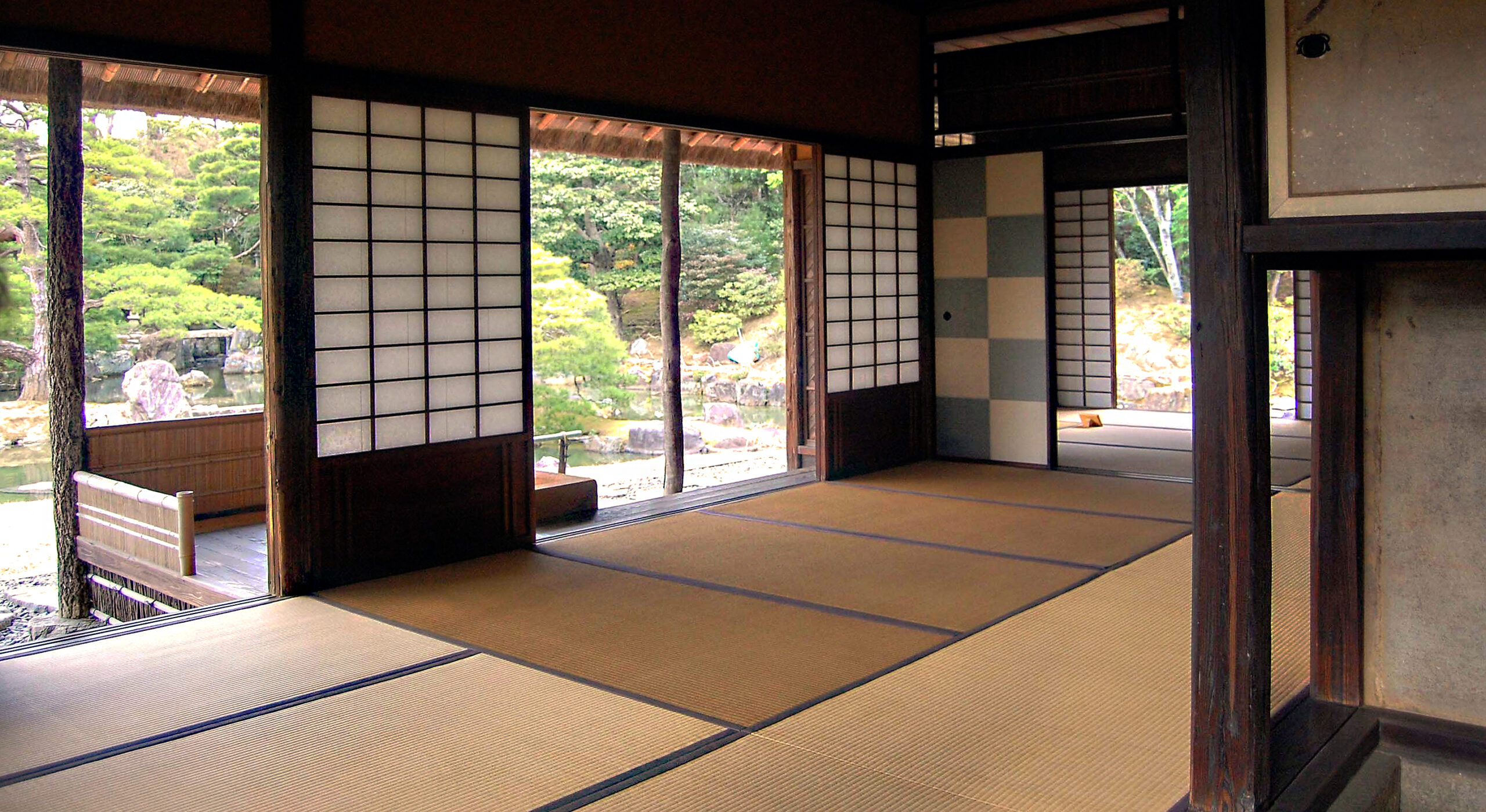
The tradition of living on tatami has been at the heart of Japanese housing for over a thousand years. Barefoot, we step onto the earthen floor and move gently onto tatami mats, feeling the earth, wood, and grass beneath us—materials that have shaped our culture. As a child, I would kick the stones from the earthen floor of my wooden house and walk up to the living room, where tatami mats lay. Most homes were simple, one-story wooden houses, with only a few grander two-story houses in the city center or countryside. In the guest room, freshly reupholstered tatami mats absorbed the warmth of the winter sun. Lying on the tatami, the scent of rush grass and the soft touch of woven fabric comforted my skin, leaving a lasting memory of that unique sensation. These images and feelings are deeply rooted in the memories of all Japanese people. For those of us born in the Showa era (1926–1989), our family homes were filled with the simplicity of tiled roofs, wooden beams, walls made of clay and straw, and sliding doors of cedar and washi paper. Traditional wooden houses, with their tatami rooms, connected us to nature, where we could feel the changing seasons each day.
Japanese wooden architecture follows the standard dimensions of the shaku-kan-bo system, with one ken measuring 182 cm. This system, originating in the Nara period (around 700), was used as the standard for measuring length until the Meiji period, defining the spacing of pillars, the size of tatami mats, and the dimensions of doors. The beauty of this architecture lies in the uniform rhythm of the pillars, set at one ken (182 cm), creating a harmonious framework for the home. This same principle extends to tatami mats, with each mat measuring Ichiken (182 cm x 91 cm), forming a modular system for room dimensions—4.5, 6, 8, or 10 mats. Sliding doors and shoji screens, sized to fit this structure, function as flexible partitions, allowing spaces to adapt as needed. The harmony between tatami mats, sliding doors, and pillar spacing defines the elegant simplicity of traditional Japanese architecture, preserving a way of life where every element is interconnected.
The Birth of Stone Garden
In a world where industrialised civilisation reaches its limits, we sought to breathe new life into design, drawing from the deep well of Japan’s ancient culture.
As society stands still, people are rethinking their values, seeking a return to a simpler, more human way of life. In Japan, we’ve long carried the wisdom of living in harmony with nature, a belief passed down through generations. Could this unique wisdom shape contemporary furniture design?
We believed it could. Not just in the form of ‘Japanese design’—superficial and brief—but in a deeper, fundamental shift. We envisioned a new way to approach furniture, one that honors Japan’s view of nature, spirituality, and space.
The result is Stone Garden, a creation rooted in the essence of Japanese culture, craftsmanship, and materials. It embodies a way of life built on centuries of wisdom, designed to offer a fresh perspective on modern living. Through it, we hope to share Japan’s unique way of being with the world.
Traditional Japanese Architecture and the Stone Garden
Traditional Japanese buildings often feature softwoods like cypress and cedar, materials that are both gentle and strong. These trees grow straight and have a beautiful, simple grain that makes them easy to shape and durable. The Horyu-ji Temple in Nara, built 1,300 years ago, still stands today, with the same wood preserving its strength. Many temples and townhouses in Kyoto, built from cypress and cedar, have lasted 500 to 1,000 years, their beauty unchanged.
The Japanese people, who built these lasting structures, developed a deep respect for nature. They practiced sustainable forestry, growing and caring for forests over centuries. When trees were cut for temples and shrines, new ones were planted. This commitment to nature has helped produce timber that is both strong and beautifully crafted, such as the Yoshino cedars of Nara and Akita cedars from Akita, which have been carefully nurtured through generations.
This heritage continues in the products of the Stone Garden, crafted from Akita cedars using traditional timber-frame construction methods, connecting the present with the timeless beauty of Japan’s architectural past.
The tatami mats used in ‘Stone Garden’ are made from natural Igusa grass, carefully grown by Igusa farmers in Kumamoto Prefecture. As the production of tatami mats has been declining in recent years, industrial substitutes like urethane have taken their place. However, ‘Stone Garden’ stays true to tradition by using natural straw flooring, preserving the rich texture of traditional Japanese tatami.
In addition, the sheet mattresses used for sofas and beds were developed in collaboration with a long-established futon manufacturer in Kyoto. These mattresses are crafted using the traditional drawn-in cloth binding technique, with natural materials such as camel hair used for the inner filling. The surface is made with original textiles from Kokura Orimono, focusing on cotton and other natural fibers throughout. Every detail is thoughtfully designed with a commitment to preserving the beauty of traditional craftsmanship.
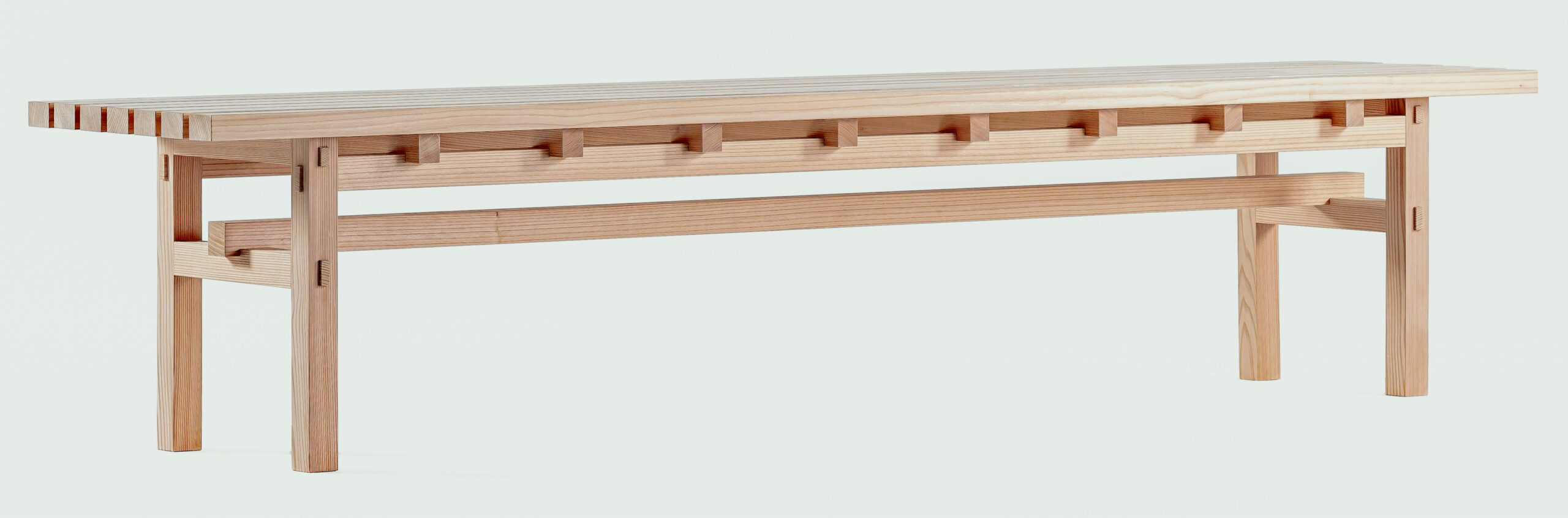
Structure and craftsmanship of Stone Garden
The Stone Garden is crafted from Akita cedar, a wood that has matured slowly in the cold, quiet regions of Akita Prefecture. The cedar is transformed into shoji screens and window frames, each one shaped by the hands of a sashimono-shi, a master craftsman, using traditional wooden joinery.
The delicate grain of the cedar is brought together using hoso and hoso-ana, a traditional technique that strengthens the wood without the need for nails or metal. This construction relies only on timber framing and gluing, following the methods of classical architecture. Though the Akita cedar is a softwood, its strength is ensured by these time-honored techniques, allowing it to bear heavy loads as the pillars of ancient buildings once did.
While hardwoods are usually chosen for furniture, the fine texture and grain of Akita cedar make it the ideal material for ‘Stone Garden,’ where tatami mats and pedestals of Japanese origin blend with a design that evokes the beauty of traditional architecture.
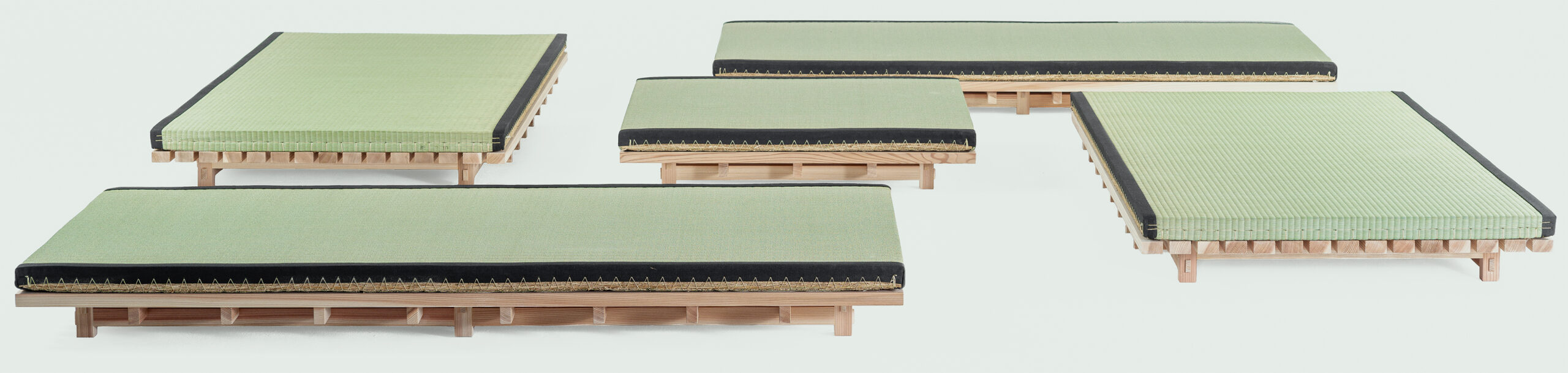
Stone Garden for flexible spaces
Stone Garden features a modular design that adapts to a variety of spaces. By combining wooden base frames of Akita cedar with tatami mats and seat mattresses, it can function as a sofa system in living rooms or as a flexible seating arrangement in lounge areas. Its versatility extends to the bedroom, where it can be used as a bed, seamlessly blending Japanese taste with modern design.
In addition, Stone Garden creates a space reminiscent of a traditional tea room, allowing the beauty of Japanese culture to be integrated into modern living. The name “Stone Garden” symbolizes an aesthetic deeply rooted in Japanese life, reinterpreting the essence of classic Japanese gardens where rocks represent islands and mountains in the sea. It serves as a platform for bringing traditional Japanese aesthetics into contemporary spaces, enriching modern living with the spirit of Japan.

Japanese residential culture and the Stone Garden concept
Japanese architecture embraces nature, blending living spaces with the changing seasons. Unlike the grand stone structures of the West, Japanese homes are built to harmonize with their surroundings.
Opening the shoji, the distant mountains unfold, and the garden adds color to the scene. Carp swim in the pond, and stones connect the garden to the mountains beyond. Sunlight dances on the water’s surface, spilling gently through the eaves and casting soft light onto the tatami. This light, reflected from the trees and pond, creates a serene beauty that defines the quiet elegance of Japanese living.
The spirit of ‘sitting on half a tatami mat, sleeping on one’
The phrase “sitting on half a tatami mat, sleeping on one” embodies the Zen and samurai philosophy of simplicity. At its core, it reflects the Japanese spirit of living modestly, valuing what is essential and refraining from excess. This philosophy remains relevant today, offering a profound sense of spirituality within the space of a single tatami mat. How can we carry this tradition into modern life? By living with tatami and in harmony with nature, we open new possibilities for future living spaces. Stone Garden seeks to reimagine the essence of Japanese housing in today’s world, respecting the beauty of ma (space) and its connection to nature, and transforming it into a new design that connects the Japanese sense of beauty with the future.
articles / interviews